July 29, 2026
Japan Luggage Express

Japan Luggage Express Ltd.
Can I Bring Concerta to Japan?
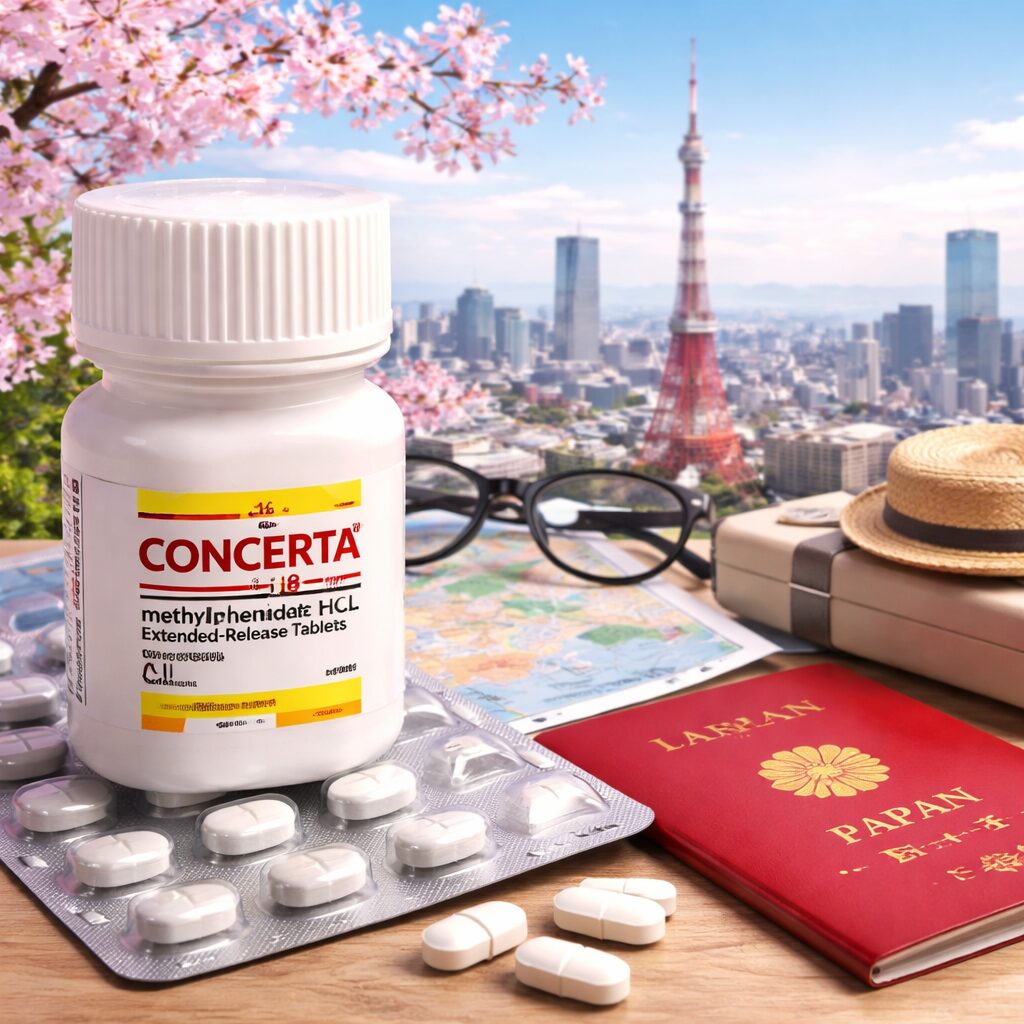
Can I Bring Concerta to Japan?
If you are planning a trip to Japan and you take Concerta for ADHD, one of the most important questions to check before flying is whether the medication is allowed into the country.
The reassuring news is that Concerta is not automatically banned in Japan. However, that does not mean every traveler can bring any amount without preparation. The answer depends on how much you are carrying, whether it is for your own medical use, and whether you have the right supporting documents.
Because Concerta contains methylphenidate, Japan treats it as a psychotropic substance, not as an ordinary over-the-counter medicine. That means travelers should be careful, especially if they plan to bring a longer supply.
In this guide, I will explain the rules in plain English, when paperwork may be needed, and what steps are safest before traveling.
The short answer
Yes, in many cases you can bring Concerta into Japan for your own personal medical use.
But there are conditions.
In general:
- Small personal-use amounts may be brought in without advance permission if they stay within Japan’s psychotropics threshold.
- Larger amounts require extra documentation, and if the amount exceeds a one-month supply, travelers may also need to contact the pharmaceutical import side of the Ministry of Health, Labour and Welfare.
- The medicine must be prescribed to you, carried by you, and kept in its original packaging.
- You should also travel with a doctor’s letter or prescription copy, even when advance permission is not required.
So the real answer is not simply yes or no. It is more accurate to say:
Yes, but only if you follow Japan’s rules carefully.
Why Concerta requires extra attention
Many travelers assume that if a medicine is legally prescribed in their home country, it will be accepted everywhere else. Japan does not work that way.
Japanese authorities divide medicines into categories such as narcotics, stimulants, stimulants’ raw materials, psychotropics, and prohibited substances. Each category has different rules.
Concerta’s active ingredient, methylphenidate, is treated in Japan as a psychotropic. That matters because psychotropics are handled under separate import rules. Travelers are allowed to carry some psychotropic medicines for personal use, but only within clearly defined limits.
This is why it is risky to rely on vague online advice such as “ADHD medicine is banned in Japan” or “a prescription is enough.” Both statements are too simplistic.
Is Concerta banned in Japan?
No, Concerta itself is not broadly banned in the same way that some amphetamine-based ADHD medications are.
That is an important distinction.
Some travelers confuse Concerta with medications that contain amphetamine or related substances. Those can fall under much stricter Japanese controls, and some are not allowed for travelers even if they are prescribed overseas.
Concerta is different because it contains methylphenidate. In Japan’s controlled-substances framework, methylphenidate is listed as a psychotropic. That means it is controlled, but it is not automatically prohibited for a traveler carrying it for legitimate treatment.
How much Concerta can you bring?
This is where travelers need to pay close attention.
Japan publishes a list of psychotropics together with quantity thresholds. For methylphenidate, the listed threshold is 2.16 grams.
If the total amount of methylphenidate you are carrying is equal to or below that threshold, and it is not in injection form, you may generally bring it into Japan without advance permission under the psychotropics rules.
However, that does not mean you should pack carelessly.
Why the dose matters
Concerta tablets come in different strengths, such as 18 mg, 27 mg, 36 mg, or 54 mg. Because the legal threshold is based on the amount of methylphenidate, not simply the number of tablets, the total number of tablets you can carry depends on your dosage.
For example:
- 18 mg tablets: 2.16 g equals 120 tablets
- 27 mg tablets: 2.16 g equals 80 tablets
- 36 mg tablets: 2.16 g equals 60 tablets
- 54 mg tablets: 2.16 g equals 40 tablets
This means a traveler taking higher-dose tablets can reach the threshold more quickly.
What if your supply is larger?
If the amount of Concerta you are bringing is more than the psychotropics threshold, Japan’s guidance says you should carry a doctor’s certificate.
That certificate should clearly include:
- your name
- your medical condition
- why the medication is necessary for your treatment
- the medicine name
- the strength and dosage
- the quantity prescribed
- the prescribing doctor’s signature
- the date of issue
There is another important point: if you are bringing more than one month’s supply, the Ministry of Health, Labour and Welfare instructs travelers to contact the pharmaceutical import side for further guidance. In practice, this is the point where people may need to apply for a Yunyu Kakunin-sho or another import confirmation depending on the circumstances.
So if you are staying in Japan for an extended period, it is smart not to guess. Contact the relevant office well before departure.
The safest way to travel with Concerta
Even when your amount appears to be within the allowed range, the safest approach is to prepare as though an airport or customs officer may ask questions.
1. Keep the medicine in the original pharmacy container
Do not place Concerta into an unmarked pill organizer if you are crossing the border. The original labeled package helps show:
- your name
- the prescribing doctor or pharmacy
- the medicine name
- the strength
- the dosage instructions
2. Bring a copy of your prescription
A prescription copy is not always enough by itself for every controlled substance issue, but it is still very useful. It helps confirm that the medicine is lawfully prescribed to you.
3. Bring a doctor’s letter
Even if your quantity seems acceptable, a doctor’s letter can prevent stress. The letter should state that you are under treatment, that Concerta has been prescribed for you, and that the medication is necessary during your travel period.
4. Carry only what you realistically need
Travelers sometimes create problems for themselves by packing several months of medication “just in case.” With controlled medicines, that can trigger extra procedures.
5. Carry it in your hand luggage
If your medication is medically necessary, it is usually wiser to keep it with you rather than put it in checked baggage. That reduces the risk of loss and makes it easier to explain at customs if needed.
What documents should your doctor’s letter include?
A strong doctor’s letter should be simple, factual, and specific. It should contain:
- your full name
- date of birth
- diagnosis or condition being treated
- medicine name: Concerta / methylphenidate
- tablet strength
- daily dosage
- total quantity carried
- statement that it is for your personal treatment
- travel dates if possible
- doctor’s name, signature, clinic details, and date
A vague note saying only “this patient uses medication while traveling” is less helpful than a detailed letter.
What mistakes should travelers avoid?
When people run into problems bringing medicine into Japan, it is often because of avoidable mistakes rather than because the medicine itself is forbidden.
Common mistakes include:
- assuming all prescription drugs are treated the same
- bringing too large a supply without checking thresholds
- carrying loose tablets without the original label
- relying only on informal internet posts or social media comments
- mixing up Concerta with amphetamine-based ADHD medications
- waiting until the last minute to contact Japanese authorities
Concerta vs. other ADHD medications
This topic causes a lot of confusion.
Some ADHD medications that are common in other countries are treated much more strictly in Japan. For example, amphetamine-based medicines may be prohibited or require a very different legal analysis.
That is why travelers should never assume that a rule for one ADHD medication automatically applies to another.
Concerta is methylphenidate-based, not amphetamine-based, and that difference is crucial.
What should you do before your trip?
If you want the lowest-risk approach, follow this checklist before flying:
- Confirm that your medicine is Concerta / methylphenidate.
- Calculate the total amount of methylphenidate you will carry.
- Check whether that total stays within the Japanese psychotropics threshold.
- Obtain a doctor’s letter with detailed information.
- Keep the medication in its original labeled packaging.
- If you are carrying more than one month’s supply or are unsure about the rules, contact the relevant Japanese authority well before departure.
Final answer: can you bring Concerta to Japan?
Yes, many travelers can bring Concerta to Japan, but they should do so carefully and with proper preparation.
For most short trips, the key issues are whether:
- the medication is truly for your own personal use,
- the total amount of methylphenidate stays within the allowed psychotropics threshold,
- and you carry proper supporting documents such as the original prescription label and a doctor’s letter.
If you are bringing a longer supply, or if your dosage is high enough that the total amount becomes large, you should not rely on guesswork. Contact the Japanese authorities in advance and confirm exactly what paperwork is needed.
When it comes to controlled medication, being overly careful is far better than being turned away at the border or having your medicine confiscated.
Conclusion
Traveling to Japan while taking Concerta is possible, but it requires a little homework. The important point is not to panic and not to assume. Concerta is not simply “banned,” yet it is also not something travelers should treat like an ordinary bottle of vitamins.
With the right preparation, the process is usually manageable:
- verify the active ingredient,
- check your quantity,
- prepare a doctor’s letter,
- and confirm any required paperwork well before departure.
That extra preparation can make the difference between a smooth arrival and a very stressful one.