
Can You Ship to Europe Without HS Codes? A Real EMS Case Study
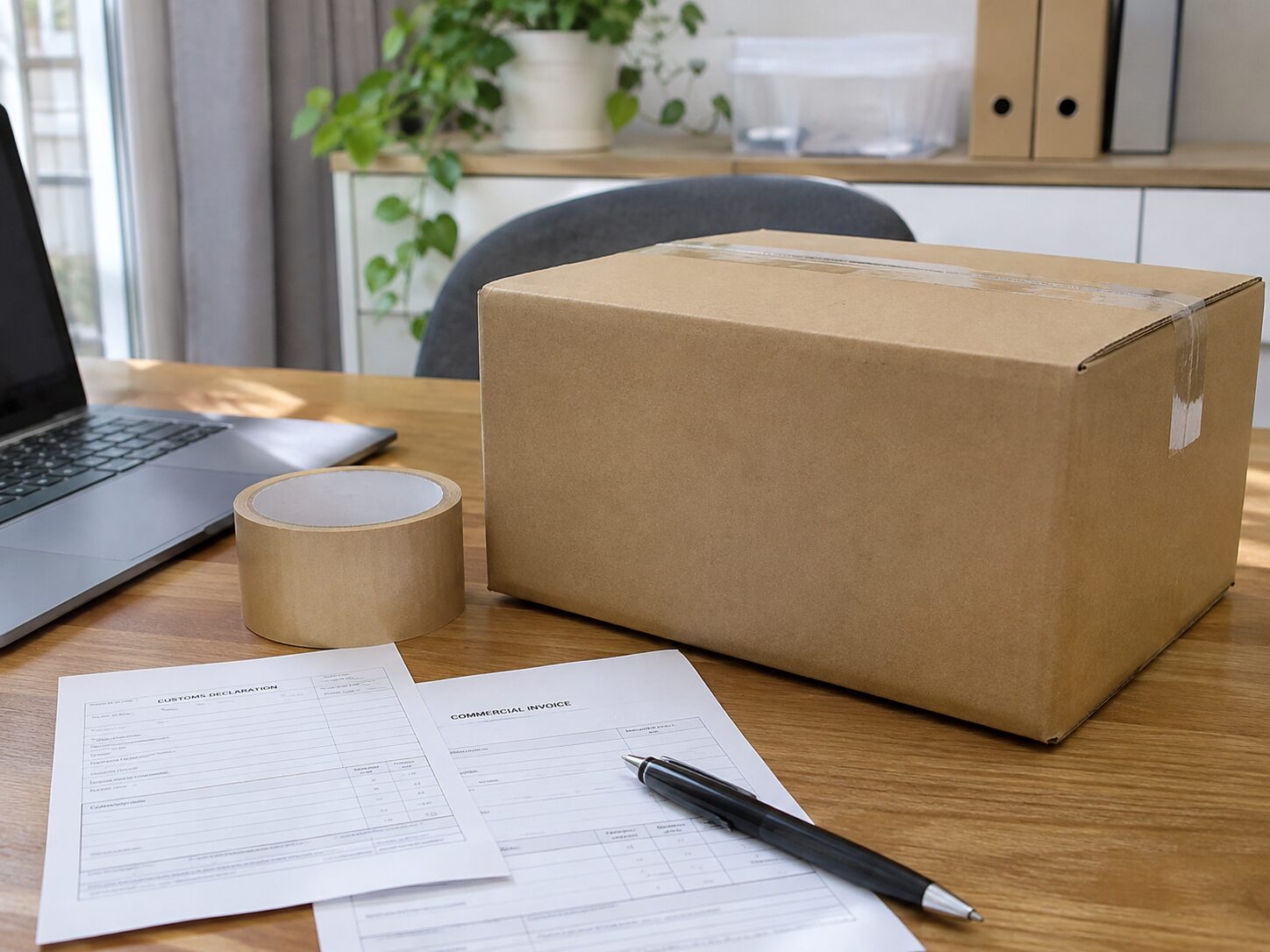
Can you send a parcel from Japan to Europe by EMS without entering HS codes? This is a question that many people face when preparing international shipping documents, particularly when sending used clothing, personal effects, or belongings left behind during a trip.
In November 2026, Japan Luggage Express handled an actual shipment that provides a useful example. A parcel containing a traveler’s lost personal belongings was sent from Japan to the Netherlands by Japan Post EMS. We entered detailed descriptions, quantities, and values for the contents, but left the HS code fields blank. The parcel was accepted in Japan, processed through customs in the Netherlands, and delivered to its destination.
The result was successful delivery. However, this is one documented case, not proof that all EMS shipments to Europe will clear customs without HS codes. In this article, we explain the shipment, the documents we prepared, what the tracking history showed, and the important limits of this experience.
EMS to the Netherlands Without HS Codes: Our Case Study

The shipment began with a family that had visited Japan. During their journey to Narita Airport on the Narita Express, they accidentally left behind a shoulder bag containing baby clothes, other garments, footwear, and personal items.
JR East located a matching bag, and the property was transferred to Narita Airport Police Station. Japan Luggage Express assisted the owner with the identification and release procedures. The police carefully checked the train journey details and the bag’s characteristics before arranging domestic delivery to our office.
After the owner confirmed the bag from a photograph, we kept its transparent protective wrapping intact and packed it in a sturdy cardboard carton for international shipping. The contents had been listed by the owner from memory; we did not unwrap the bag and individually inspect the garments.
| Shipment detail | Actual information | |
|---|---|---|
| Origin | Chiba, Japan | |
| Destination | The Netherlands | |
| Shipping service | Japan Post EMS | |
| Contents | Lost personal belongings, primarily clothing and footwear | |
| Packed weight | 8.2 kg | |
| Declared goods value | JPY 15,904 | |
| HS codes entered | None | |
| Date accepted by Japan Post | November 6, 2026 | |
| Date delivered in the Netherlands | November 14, 2026 | |
| Result | Delivered, without being returned to Japan | |
This was a non-commercial return of belongings to their original owner, rather than a retail purchase or a shipment intended for resale. That distinction was explained in the shipping paperwork, but it did not remove the need to declare the individual contents.
Does Japan Post Require HS Codes for EMS Shipments to Europe?
Japan Post’s published answer is more nuanced than a simple yes or no. Its official FAQ states that entering an HS code on the shipping label is not mandatory. At the same time, it warns that customs authorities in some European destinations may regard advance electronic customs data as insufficient if HS codes are omitted. The possible consequences include customs delays and return of the parcel.
For the original explanation, see Japan Post: What is the HS code? Do I have to enter it?
Acceptance in Japan is not the same as clearance in Europe
There are two separate stages to consider. First, Japan Post decides whether it can accept the international parcel in accordance with its posting requirements. Later, customs authorities in the destination country decide whether the submitted information is sufficient for import processing.
Japan Post accepting a parcel without HS codes does not guarantee that the destination country will release it. A sender who proceeds without codes should understand this distinction before paying for international postage.
Electronic customs data is still required
For international mail containing goods, the sender must provide the required Electronic Advance Data (EAD), including the sender’s and recipient’s details and information about the contents. Omitting HS codes does not mean that the sender can omit the customs declaration or describe the shipment merely as “personal effects.”
We created the EMS documents using Japan Post’s International Mail My Page Service. The item names, quantities, and declared values were entered into the system, while the HS code fields were left blank. We did not attempt to add guessed classification numbers merely to fill the spaces.
Why We Chose to Proceed Without HS Codes in This Case

One of the difficulties with this particular shipment was the nature of the contents. The bag included many pieces of used baby clothing. To assign accurate tariff classification codes to clothing, it can be necessary to establish the exact garment type, whether the fabric is knitted or woven, the relevant size category, and the fibre composition.
A general description such as “baby clothing” does not supply all of that information. Even a photograph of a garment cannot reliably establish whether it contains 100% cotton or a mixture of cotton, polyester, and nylon. When material labels are missing or unreadable, accurate identification becomes especially challenging.
Moreover, the owner was already back in the Netherlands and had prepared the packing list from memory. The bag was still wrapped as it had been received from the police. Opening it, photographing each garment, and investigating its composition would have involved substantial additional work, without necessarily making every material identifiable.
We discussed the problem with the owner in detail. We explained that Japan Post could accept the EMS parcel without HS codes, but Dutch Customs could delay the shipment, require further information, assess charges, or return it. The owner expressly acknowledged and accepted those risks before authorizing shipment.
This was a decision made for the circumstances of one shipment. We are not suggesting that other senders should routinely omit HS codes, especially when correct codes can be identified and entered.
How We Prepared the Customs Declaration Without HS Codes
Not entering HS codes did not mean using vague or incomplete product descriptions. On the contrary, we spent time converting the owner’s packing list into the individual item entries required for the Japan Post customs declaration and accompanying invoice.
We did not declare the whole parcel as “clothing”
Instead of listing everything under “Baby clothes,” “Clothing,” or “Personal effects,” we used descriptions identifying the kinds of articles in the parcel. The actual declaration contained separate entries for the different garment categories and other items.
| Examples of declared contents | Quantity | Declared amount |
|---|---|---|
| Men’s printed T-shirt | 1 | JPY 2,000 |
| Socks purchased at Lawson | 2 pairs | JPY 2,200 |
| Socks purchased at 7-Eleven | 2 pairs | JPY 2,200 |
| Socks purchased at FamilyMart | 2 pairs | JPY 2,200 |
| Used baby shorts | 2 | JPY 300 |
| Used baby trousers | 4 | JPY 400 |
| Used baby T-shirts | 4 | JPY 400 |
| Used baby long-sleeve shirts | 4 | JPY 400 |
| Used baby bodysuits | 6 | JPY 600 |
| Used shoulder bag | 1 | JPY 800 |
The complete declaration also included other items, such as towels, a dress, shoes, sandals, baby socks, a sweater, sleepwear, and a fitted sheet. The table above is an illustrative extract from the actual itemized declaration, not the entire packing list.
Why we kept socks from three stores as separate entries
Six pairs of newly purchased socks came from three different convenience-store chains in Japan. We considered consolidating the six pairs into one line, but chose to preserve the owner’s three separate entries. Socks purchased at different stores could have different material compositions or specifications, and we did not have reliable information showing that they were identical.
Keeping them separate was a simple way to preserve the distinction in the owner’s list. The store names were included for identification, not because the name of a store substitutes for a fibre description or an HS code.
We adjusted unit values and added the bag itself
Japan Post’s invoice format calculates line totals from unit prices and quantities. One entry in the customer’s list assigned a total value of JPY 200 to six pairs of used baby socks, which could not be divided evenly into whole-yen unit prices. We entered JPY 34 per pair, resulting in JPY 204 for that line.
We also noticed that the shoulder bag itself was missing from the original packing list. We added it with an estimated used value of JPY 800 and informed the owner of that estimate.
The resulting declared value was JPY 15,904, compared with JPY 15,100 on the original list. These were declared values for customs purposes, not sale prices. The adjustments were discussed with the owner during document preparation.
The remarks explained why the goods were being returned
Japan Post’s online shipping system provides a remarks field that can print additional information on the customs declaration and invoice. In this case, we entered the following text:
Personal belongings left behind during travel in Japan, returned to the original owner in the Netherlands. Not for sale.
This described the circumstances and non-commercial purpose of the shipment. It was supplementary information; it did not replace the individual declarations of goods and was not a guarantee of any particular tax treatment.
Why Detailed Descriptions Still Matter When HS Codes Are Missing

hs code harmonized commodity description and coding system concept with big word or text and team people with modern flat style – vector illustration
There is an important difference between omitting a classification code and failing to describe the goods. Customs officials still need to understand what the shipment contains.
The European Commission’s guidance on goods descriptions identifies general terms such as “Clothing” as insufficient and gives more specific garment descriptions as better alternatives. The guidance explains that customs authorities need precise descriptions to identify goods and assess risks, particularly when a commodity code is not supplied.
Readers can consult the European Commission’s guidance on acceptable and unacceptable goods descriptions (PDF).
In practical terms, “Used baby trousers – 4 pieces” tells customs much more than “Personal belongings – 1 bag.” For clothing, descriptions that also give the verified material and construction are better where that information is available. A detailed name is not a substitute for an HS code when the destination requires one, but it is still essential information.
Similarly, the fact that something is a personal effect or a returned item does not mean that its contents can be left unidentified. Duty relief and customs documentation are two separate questions.
What Actually Happened at Dutch Customs?

The EMS tracking history provides the clearest evidence of the shipment’s result. The parcel was accepted by Japan Post on November 6, left Japan on November 7, arrived in the Netherlands on November 9, and was released back into the postal network after customs processing on November 13.
| Date and time | Tracking event | Location |
|---|---|---|
| November 6, 2026, 15:33 | Accepted by Japan Post | Kashiwa, Japan |
| November 7, 2026, 06:20 | Dispatched from outward exchange office | Tokyo, Japan |
| November 9, 2026, 18:15 | Arrived at international exchange office | Den Haag, Netherlands |
| November 9, 2026, 18:28 | Customs processing | Den Haag, Netherlands |
| November 13, 2026, 10:43 | Received from customs | Den Haag, Netherlands |
| November 14, 2026, 15:35 | Delivered | Netherlands |
Times for events outside Japan are local times shown in the tracking record. The parcel reached the Netherlands three calendar days after postal acceptance and was marked delivered eight calendar days after acceptance.
Most importantly, the tracking record showed delivery, not a customs rejection or return to Japan. In this shipment, the absence of HS codes did not prevent final delivery.
What the tracking record does not tell us
We should be careful not to read more into the tracking events than they actually prove. A status showing that a parcel was presented to customs does not establish that officers physically opened it. The record also does not say why the parcel was released, whether additional information was considered internally, or whether the recipient was charged import VAT, customs duty, or a postal clearance fee.
As of the publication of this case study, we had verified the delivery status, but had not independently confirmed the final amount, if any, paid by the recipient to PostNL or Dutch Customs.
It would therefore be inaccurate to claim that the parcel received a tax exemption simply because it was delivered.
Are Forgotten Personal Belongings Automatically Duty-Free in the Netherlands?
No automatic exemption should be assumed. During this case, the owner researched the Dutch Customs Handbook and found a provision relevant to belongings left behind during travel.
Section 9.3 of the Dutch Customs Handbook on travelers’ personal baggage addresses forgotten goods that are sent after the traveler has departed. It indicates that such goods may be treated as personal baggage and discusses the possibility of relief for returned goods, subject to the relevant conditions.
That is useful information for travelers recovering items from overseas. But eligibility for relief is not the same as an approved exemption. Depending on the circumstances, documentation and an application may be necessary, and the postal operator’s standard import clearance process may not automatically apply the relief.
This is particularly important for EMS parcels, where the destination postal operator ordinarily handles customs clearance. A traveler whose belongings are being returned should ask the destination postal service or customs authority what evidence and procedures are required if an exemption is sought.
In this case, we can report that the parcel was delivered. We cannot report, without further evidence, that Dutch Customs granted a duty or VAT exemption.
Does This Mean You Can Ship to Other European Countries Without HS Codes?

Not necessarily. The Netherlands is a member of the European Union, and EU customs data requirements affect many shipments to member countries. Nevertheless, customs processing can differ according to the destination country, the type of goods, the postal service, the data supplied, and the decisions made during import clearance.
Furthermore, Europe is not identical to the EU. Japan Post also publishes destination-specific information about the relevant classification codes. For example, its European guidance identifies six-digit HS codes for the Netherlands and Germany, while indicating different code lengths for certain other destinations, including France and Ireland.
Our shipment cannot establish what would happen to a parcel sent to France, Italy, Germany, Spain, the United Kingdom, Switzerland, or any other European destination. Nor does it establish that the next parcel sent to the Netherlands without HS codes would receive the same treatment.
If the correct HS codes can be determined reliably, we recommend entering them in accordance with Japan Post’s guidance. Our case study documents what happened when accurate codes were not available for a mixed assortment of personal belongings and the owner knowingly accepted the risks of proceeding without them.
Frequently Asked Questions About EMS and HS Codes
Can Japan Post accept an EMS parcel to the Netherlands without HS codes?
Japan Post’s official FAQ says that HS code entry is not mandatory for the label, while warning of possible delays or returns at the destination. In our November 2026 case, Japan Post accepted a parcel to the Netherlands with no HS codes entered. Acceptance by Japan Post does not guarantee destination customs clearance.
Did your parcel really reach the recipient in the Netherlands?
Yes. The official EMS tracking record showed delivery on November 14, 2026. For customer privacy, we do not publish the recipient’s identity, home address, or tracking number in this case study.
Can I simply write “personal effects” instead of listing the contents?
No. The shipping purpose may be described as personal effects or returned belongings, but the individual types of goods still need to be described with appropriate quantities and values. In our case, clothing was separated into entries such as baby trousers, T-shirts, socks, and bodysuits.
Are HS codes and detailed goods descriptions the same thing?
No. An HS code is a classification number, while the goods description explains in words what the article is. A sender may be able to submit a detailed description without an HS code, as we did, but this does not remove any destination-country requirements or eliminate customs risk.
Will a parcel of lost personal belongings be exempt from import tax?
Not automatically. The existence of possible relief for personal baggage or returned goods does not prove that relief has been granted for a particular postal shipment. The actual conditions and application procedures must be checked with the destination postal operator or customs authority.
Should I leave HS codes blank if I am unsure of the classification?
Our experience should not be taken as a recommendation to omit them. First try to identify the correct code from the product information and official classification resources. If information is genuinely unavailable, ask Japan Post and the destination authorities about the requirements and risks rather than inserting a guessed code.
Our Conclusion: One Successful Shipment, Not a General Guarantee
Our November 2026 EMS shipment from Japan to the Netherlands is a concrete example of a parcel delivered successfully without HS codes. We prepared an itemized customs declaration, entered an accurate explanation of the shipment’s purpose, obtained the owner’s informed agreement to the risks, and retained the official tracking history documenting customs processing and delivery.
But the most important lesson is not that HS codes are unnecessary. It is that Japan Post’s acceptance requirements, destination customs requirements, accurate descriptions of contents, and eligibility for duty relief are separate issues. Understanding each one helps senders make an informed decision.
We are sharing this case because discussions about missing HS codes often stop at the question, without showing the final outcome. This shipment provides one real result—successful delivery—while also illustrating why other shipments may turn out differently.
Need Help Retrieving and Shipping Lost Belongings from Japan?
Japan Luggage Express assists overseas travelers with the retrieval and international shipping of lost personal belongings from locations in Japan, including police stations, transport operators, and hotels where collection arrangements are possible.
If your belongings have been found in Japan and you need them sent to your country, please contact us with the item description, current storage location, destination country, and approximate size or weight. We can review the available collection and shipping options and provide a quotation.
Request a Quote for Lost Item Retrieval and/or International Shipping
Case study published in November 2026. The customs and postal requirements described here may change. Please check the current Japan Post and destination-country guidance before sending your own parcel.